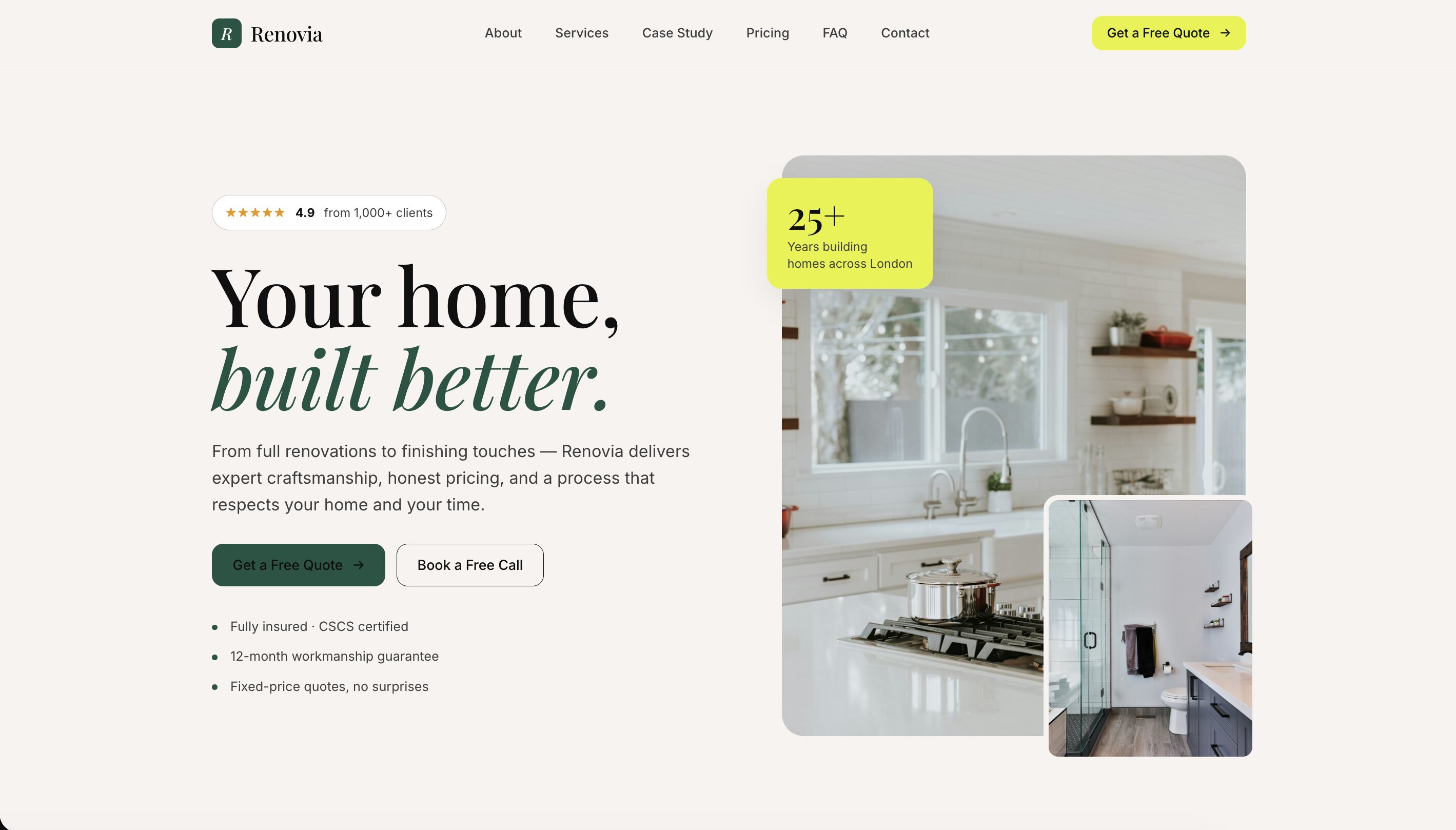
Websites for UK painters and decorators — before-and-after on every job, colour consultations, spray and heritage work shown separately, and a quote form that starts with a photo of the room.
The closest builds in our library for decorating work — open either one to see how a before-and-after gallery and a room-by-room service list read to a homeowner.
Nobody can tell a good decorator from a cheap one until the second coat is on. Customers judge on the only evidence available before they commit: photographs of finished rooms, and whether the firm looks like it will cover the carpets and clear up afterwards.
Show the finish, close up.
Cut-in lines, straight edges against coving, a sprayed door that looks factory-finished. Detail photography sells decorating in a way a wide shot of a beige room never does — and it is what separates you from a day-rate quote.
Before-and-after is the whole sale.
A tired hallway next to the finished one does more than any paragraph you could write. Every job gets a slider, the products used, how long it took, and whether the customer stayed in the house while you worked.
Win domestic and commercial on different pages.
Homeowners want colour advice and tidiness. Landlords, letting agents and facilities managers want void turnarounds, out-of-hours working and a price per room. Same trade, different pages, different search terms.
Prove you'll leave the house clean.
Dust sheets, masked edges, a daily tidy-up, respect for the house. Say it plainly with photos of a protected room mid-job, and put your public liability cover, Dulux Select or Johnstone's Trade status and PDA membership in the header with numbers that check out.
What's in the site
Built around how decorators win work.
Every feature earns its place by showing the finish, answering the tidiness question, or shortening the path from a photo of a room to a booked start date.
01
Before-and-after slider on every job.
Drag-to-reveal on the same camera angle, with the room type, the products used, days on site and whether the customer lived in during the work. Each job is its own page, so each one ranks.
02
A page per type of decorating.
Interior painting, exterior masonry and render, wallpapering, spray finishing, staircases and spindles, kitchen respraying, heritage and period property work, commercial voids — named separately, because customers search for the job rather than for decorating.
03
Colour consultation booking.
A homeowner stuck between three tester patches books a colour visit in two clicks. It is the easiest yes in decorating, and it turns a browsing visitor into an appointment without a phone call.
04
The tidy-house section.
Dust sheets, masking, protected floors, daily clean-down, working around pets and children, and what time you start in the morning. Photographed mid-job rather than written as a promise.
05
Trade credentials in the header.
Dulux Select, Johnstone's Trade, Painting and Decorating Association, CSCS, public liability cover and DBS checks for school or care work — with membership numbers linked to the register where one exists. Nothing held, nothing shown.
06
Photo-first quote form.
The customer photographs the room, adds the postcode, ceiling height and whether they want walls, woodwork or the lot. You price most jobs without driving to a site visit.
FAQ
Painter & Decorator website FAQs.
The questions painter & decorators ask before they hit the “get a price” button.
How much does a painter and decorator website cost in the UK?
A decorator website from ConstructionWebDesign starts at £1,000, fixed price. UK decorators typically pay £1,000–£3,000 for a site built for the trade, against £80–£250/month on a generic platform. Hosting and SSL are included for the first year.
How long does it take to build a decorator's website?
Seven working days from kickoff to live. ConstructionWebDesign starts from a proven decorating layout, loads your before-and-after sets, service pages, credentials and reviews, and ships it.
What should a painter and decorator's website include?
Before-and-after photography on every job, a page per type of work (interiors, exteriors, wallpapering, spraying, heritage, commercial), colour consultation booking, your accreditations and insurance, real Google reviews, a one-tap number and a photo-based quote form.
How do I get better photos of my decorating work?
Shoot the before from a fixed spot — corner of the room, phone at chest height — then shoot the after from exactly the same spot. Natural light, blinds open, no ladders in shot, plus one close-up of a cut-in edge or a sprayed door. That is the whole technique, and it doubles as your marketing.
Should I show my prices?
Show ranges rather than fixed numbers: a typical box room, a hallway, stairs and landing, a three-bed exterior. Ranges filter out the customers hunting a rock-bottom day rate without committing you to a price before you have seen the walls.
Can the site bring in commercial and landlord work as well as domestic?
Yes, on separate pages. Void turnarounds for letting agents, out-of-hours office decorating, HMO and student-let refreshes, and schools work with DBS-checked staff are different searches with different buyers, so they get their own pages rather than a line on the homepage.
Do you do SEO for painters and decorators?
Yes. Every decorating site ConstructionWebDesign builds ships with local SEO baked in: schema markup, Google Business Profile setup, postcode keywords, and a page per service and town, so both a near-me search and a kitchen respray search land somewhere relevant.
Can I add new jobs myself?
Yes, from a phone. A before photo, an after photo, the room type and a sentence — a couple of minutes at the end of a job. Adding work regularly is the cheapest ranking work a decorator can do.
More categories
Built for other trades too.
Same approach, tuned to each trade — pick yours and see a landing page built just for it.